
Understanding Foundation Settlement Repairs
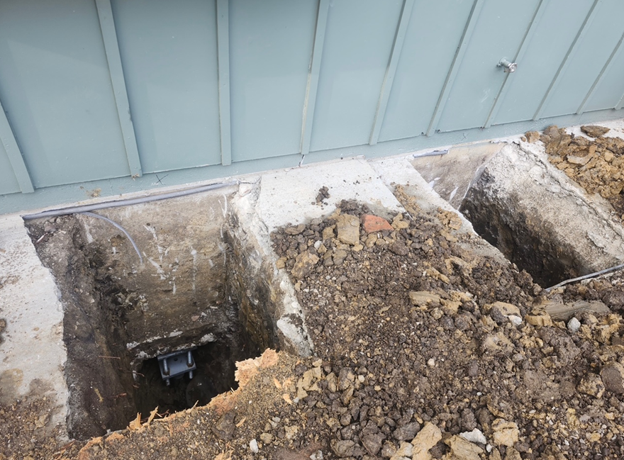
Foundation settlement can be concerning for homeowners, especially when cracks begin appearing in foundation walls or drywall, doors start sticking, and floors start sloping. Often these cracks are due to the shrinking and swelling of clay soils from moisture changes within the soil that are common in the Kansas City area, but sometimes these can be indicative of foundation settlement that requires structural repair. If it is determined that foundation settlement is occurring in the home, a licensed Professional Engineer may recommend that piers be installed beneath the foundation to provide additional support and limit future settlement.
Two common options are push piers and helical piles. Both are designed to transfer the weight of a home to more stable soil deeper underground, but they are installed differently and have different advantages. Understanding these differences can help homeowners make more informed decisions about foundation repairs.
What Are Push Piers?
Push piers are steel supports installed beneath an existing foundation. They are hydraulically pushed into the ground using the weight of the house to provide the force needed for installation. Push piers in residential applications in the Kansas City area are typically 3” diameter pipes that are driven to bedrock or refusal. Once installed, they help transfer the home's weight to deeper, more stable soil or suitable bearing material. To put it simply, push piers are giant nails and the weight of the house along with the installation equipment is the hammer.
Benefits of push piers:
Can support heavy structures
May allow portions of a settled foundation to be lifted.
Can reach deep bearing materials when necessary.
Often require relatively small excavation areas.
Potential drawbacks:
The house must provide sufficient weight to push the piers into the ground, unless another reaction system is used.
They may not be suitable for lighter structures in some situations.
Installation can be difficult where access is limited or underground obstructions are present.
Concentric vs. Eccentric Push Piers
Not all push piers are installed the same way. Two common configurations are concentric and eccentric push piers. The main difference is how the pier is positioned beneath the foundation and how the home's weight is transferred to it.
Concentric push piers: The pier is intended to be positioned directly in line with the intended load path which is generally the center of the footing. This arrangement can provide a more direct transfer of the foundation load to the pier.
Eccentric push piers: The pier is offset from the main load path, typically using a bracket attached near the edge of the foundation. This can be helpful when there is limited room to work beneath the footing or when the foundation wall may be settling and rotating outward.
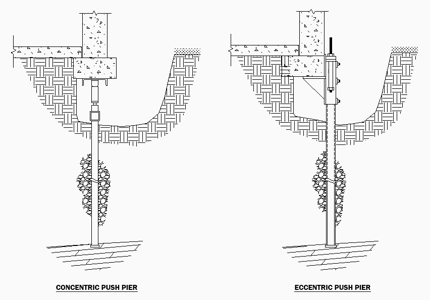
Neither type is automatically better than the other. Often, concentric piers come in shorter pier segments and eccentric piers come in longer pier segments so while concentric piers would theoretically have more capacity, the push piers lose capacity at each connection point. From my experience, both concentric push piers and eccentric push piers are more than sufficient for most residential loads if they are installed correctly.
What Are Helical Piles?
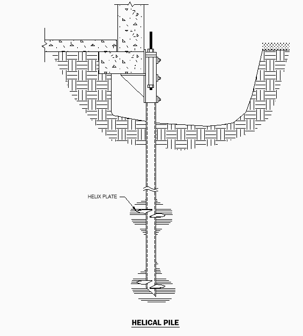
Helical piles, sometimes called helical piers, are steel supports with spiral-shaped plates attached to the shaft. Instead of being pushed into the ground, they are rotated into the soil using specialized equipment until a certain torque is met. To put this simply, helical piles are giant screws and the installation equipment is a giant drill.
As the pile advances into the ground, the plates help transfer the weight of the structure into the surrounding soil. Installers monitor the installation process, including the torque required to advance the pile, to help evaluate whether the required capacity has been achieved.
Benefits of helical piles:
Do not rely on the home's weight to advance into the ground.
Can be a good option for lighter structures such as additions, covered porches, and concrete stoops.
Provide installation feedback through torque measurements.
Can be installed in a variety of soil conditions when properly designed.
Potential drawbacks:
Rocks, boulders, and other underground obstructions can make installation difficult.
Typically not an adequate solution for heavier structures.
Push Piers vs. Helical Piles: Which Is Better?
Neither system is the best choice for every home. Push piers are often considered for heavier structures where the home's weight can provide sufficient installation resistance. Helical piles can be especially useful when a suitable reaction load is unavailable or when supporting lighter structures. The right solution depends on several factors, including soil conditions, the home's weight, foundation construction, installation access, and the depth of suitable bearing material.
Both systems can sometimes be used to lift a settled foundation. However, lifting is not always the best goal and is not typically recommended by Resolve Engineering. Attempting to raise a home too far can cause additional cracking or damage to drywall, brickwork, plumbing, and other building components. In some cases, stabilizing the foundation without significantly lifting it is the more appropriate approach.
Does Every Settled Foundation Need Piers?
Absolutely not. Cracks and other signs of movement can have several causes, including normal concrete shrinkage, seasonal soil movement, drainage problems, or actual foundation settlement.
Before selecting a repair method, it is important to understand what is causing the problem. Correcting drainage or moisture issues may be an important part of the solution, while ongoing settlement may require additional structural support.
Installing piers without understanding the underlying problem may not address all of the home's issues and in many cases can cause further damage to the home.
The Importance of an Independent Evaluation
Foundation repair can be a significant investment, and different contractors may recommend different solutions. An independent structural evaluation by a licensed Professional Engineer can help homeowners better understand the condition of their foundation, determine whether repairs are warranted, and evaluate the proposed repair approach.
At Resolve Engineering, our goal is to help homeowners understand what is happening with their homes and make informed decisions about the next steps. The best foundation repair is not necessarily the most extensive repair, but the one that appropriately addresses the underlying problem. If you are seeing issues related to foundation settlement, contact Resolve Engineering or fill out our Quick Booking Form to schedule your foundation inspection.